Tour du Mont Blanc Refuges: How to Book Your TMB Huts
Plan your Tour du Mont Blanc overnight stops with confidence. Find out when 2027 refuge bookings open, compare published prices and room options, understand half-board, and use our accommodation map to build a realistic hut-to-hut itinerary—with alternatives when your preferred refuge is full.
TMB refuge booking at a glance
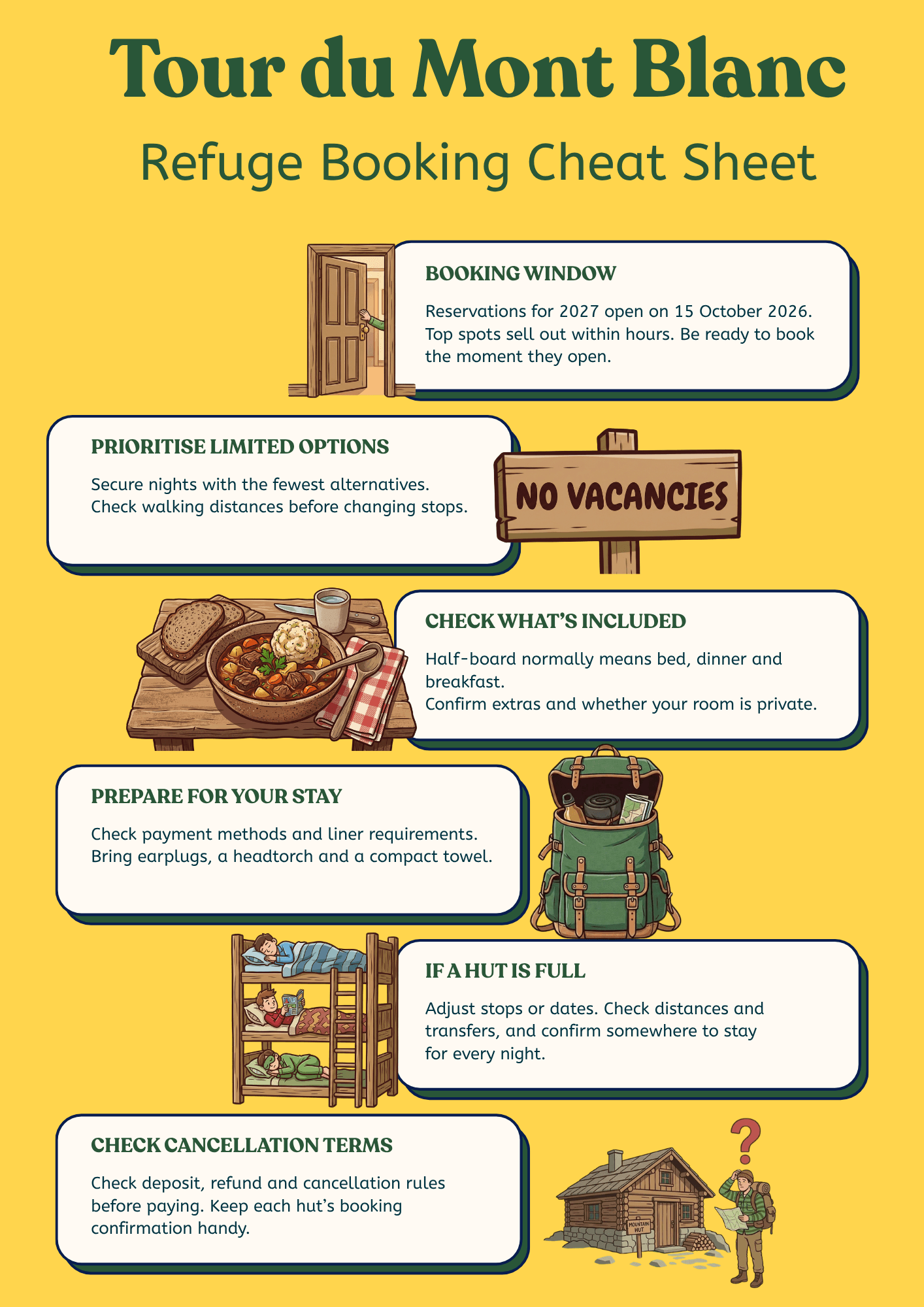
2027 booking opening
The Wardens’ Association platform opens summer 2027 reservations on 15 October 2026. Properties outside the platform may follow different schedules. Official booking announcement.
When to book
Check each property’s reservation-opening date and be ready when bookings open, especially if your dates or room requirements are fixed.
Which nights to prioritise
Start with overnight stops that have the fewest workable alternatives. Check the walking days on both sides before choosing another refuge.
Rooms and meals
Half-board normally includes a bed, dinner and breakfast. Confirm whether a smaller room is shared or reserved exclusively for your party.
Payment and overnight kit
Check accepted payment methods and carry the appropriate euros or Swiss francs. Bring a sleeping bag liner where required, plus earplugs, a headtorch and a compact towel.
If a refuge is full
Consider nearby accommodation, different dates or a revised starting point. Check distances and any transfers before committing; do not rely on an unconfirmed walk-in bed.
Continue planning with our TMB accommodation directory, Tour du Mont Blanc planning hub and complete route guide.
Tour du Mont Blanc refuges are mountain huts offering overnight accommodation along the TMB. Many provide half-board: a bed, dinner and breakfast. Booking them means organising a connected sequence of overnight stops, with walking days that suit your pace—not simply finding somewhere to sleep.
For summer 2027, reservations through the Tour du Mont Blanc Wardens’ Association platform open on 15 October 2026. Accommodation outside that platform may follow a different schedule. Check individual properties before assuming that every hut opens bookings on the same day. Official 2027 booking announcement.
This guide explains when to book, how to compare refuges, what published prices actually include and what to do when your preferred stop is full.
Start with our TMB accommodation map to see how the overnight stops fit together, or explore the Tour du Mont Blanc planning guide if you are still choosing your itinerary.
Do you need to book TMB refuges in advance?
For a hut-to-hut itinerary, advance reservations are strongly recommended, especially in high season. Popular refuges can fill months before departure. A walk-in bed should not be the foundation of your plan. If your dates are fixed, check reservation-opening dates early. Groups and hikers who need particular room arrangements have less flexibility than someone travelling alone and happy to share a dormitory.
There is no single “book six months ahead” rule that works for every property. The more useful approach is to find out when each accommodation starts accepting reservations, then be ready when that window opens. Official booking guidance.
When do Tour du Mont Blanc refuge bookings open for 2027?
The association’s booking platform opens summer 2027 reservations on 15 October 2026 for its member refuges and gîtes.
Other properties may use their own websites, request forms or email arrangements. Check their instructions directly rather than assuming the association’s date applies.
Also distinguish between two different dates:
Reservation-opening date: when you can book your bed.
Operating dates: when the accommodation will actually welcome guests.
This distinction matters particularly for early- and late-season itineraries. A bed cannot be booked for a night when the refuge is closed, even if the trail itself is accessible. Check the association’s season announcement.
How to book Tour du Mont Blanc refuges
1. Sketch a realistic itinerary
Choose your direction, starting point and overnight areas. Compare distance and ascent between stops before committing to beds.
2. Identify your least flexible nights
Prioritise stops with few workable alternatives. Build flexibility into the surrounding nights rather than booking the easiest accommodation first.
3. Compare the complete stay
Check room type, meals, price, arrival time, payment method and cancellation terms. Tell the accommodation about dietary requirements before arrival.
4. Confirm each reservation
Keep a record of dates, guest numbers, deposits and confirmation references. Download confirmations so they remain accessible without reception.
5. Check the whole sequence
Read through every night in order. Look for missing dates, duplicate bookings and walking days that have become too demanding.
The official refuge-booking guide explains the booking process and what to check before confirming.
An enquiry is not necessarily a reservation. For example, Bonatti’s booking form explicitly says that submitting it does not automatically guarantee a bed: the refuge must confirm availability. Bonatti booking instructions.
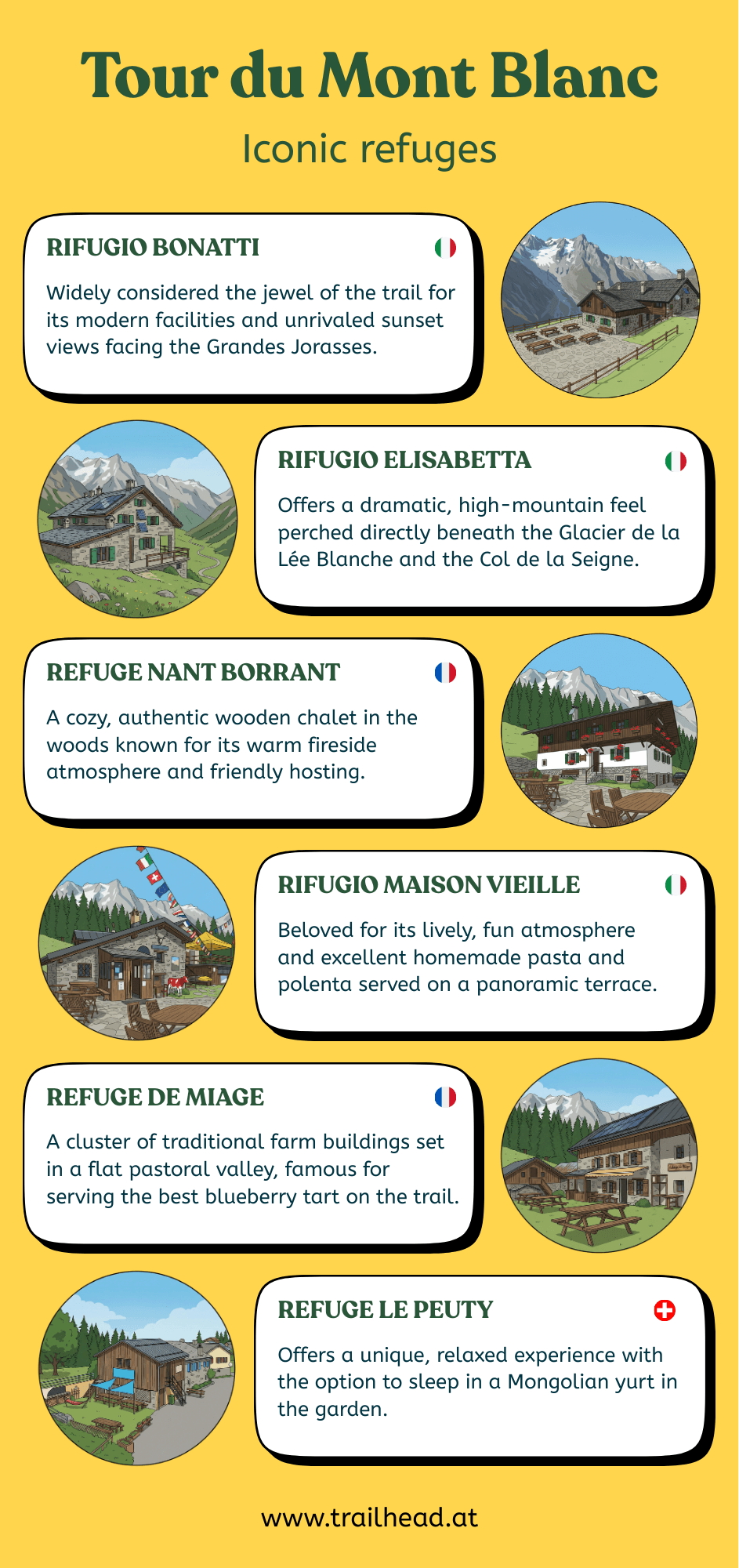
How much do TMB refuges cost?
Compare prices on a like-for-like basis. A dormitory bed with half-board is not equivalent to a private room, a bed-only booking or a hotel rate quoted for two people.
Check:
- Whether the price is per person or per room.
- Whether dinner and breakfast are included.
- Whether tourist tax is additional.
- Whether showers, towels or bedding cost extra.
- Whether a packed lunch is included or ordered separately.
- Which season the published price covers.
The examples below are published reference rates checked on 3 October 2026. They are not a guarantee of availability or the price you will pay for summer 2027. Your booking confirmation should state the applicable rate.
Refuge de la Balme: compare dormitory sizes
Location: Les Contamines sector.
The official listing currently shows:
- €71 per person: half-board in a 12-person dormitory.
- €79 per person: half-board in a four- to six-person dormitory.
- €190 for two people: half-board in the private room, with additional guests charged separately.
The listing says half-board includes the overnight stay, dinner, breakfast and a shower. It also lists summer 2027 operating dates of 12 June to 12 September.
Check the name carefully: Refuge de la Balme near Les Contamines is not Refuge du Col de Balme near the Chamonix–Swiss border. Official Refuge de la Balme listing.
Refuge des Mottets: dormitories and two-person rooms
Location: Vallée des Glaciers.
The refuge’s published 2026 rates include:
- €60 per person: half-board in the large dormitory.
- €80 per person: half-board in a four-person dormitory.
- €198 per room: a two-person room without a private shower.
- €258 per room: a two-person room with a private shower.
These are previous-season reference prices, not confirmed 2027 rates. Check taxes, inclusions and the applicable season before booking. Refuge des Mottets published rates.
Rifugio Bonatti: check the tariff year
Location: Italian Val Ferret, above Courmayeur.
Bonatti’s published rate page shows:
- €74 per person: dormitory half-board.
- €94 per person: half-board in a room with two to four beds.
- €1 per person: additional tourist tax.
The page still references the 2025 season, so these figures should not be treated as confirmed 2027 prices.
A room with two to four beds is not automatically a private room for your party. Ask what arrangement your reservation includes. Bonatti published rates.
Rifugio Elisabetta: request an up-to-date quote
Location: Val Veny, Italy.
Elisabetta’s publicly available tariff page is labelled 2024. We would not use it to calculate a 2027 budget.
Check the latest price directly, including your room category and any membership conditions. Elisabetta tariff and contact page.
Refuge Le Peuty: a small refuge in the Trient area
Location: Le Peuty, near Trient, Switzerland.
The association’s listing currently shows:
- CHF67 per person: half-board in the 19-person refuge dormitory.
- CHF70 per person: half-board in the four-person yurt dormitory.
The tariff section does not explicitly identify these as 2027 rates. Confirm the applicable price and sleeping arrangement when booking.
Remember that these prices are in Swiss francs, not euros. Official Refuge Le Peuty listing.
Use the accommodation map before committing to beds
Open the Trailhead TMB accommodation map alongside your proposed itinerary.
For each overnight stop, ask:
- Does this accommodation fit the route I intend to walk?
- What happens to both walking days if I stay somewhere else?
- Am I comparing dormitory accommodation with a genuinely private room?
- Would a valley stay require a transfer back to the trail?
- Have I checked the accommodation’s own booking information?
Use the accommodation directory when you prefer to compare properties in a list.
Treat the map as a planning aid. A listing does not mean a bed is available, and two nearby map pins may represent very different walking days.
What if your preferred refuge is full?
Look at accommodation before and after your original stop, then check the effect on both neighbouring stages. An alternative only works if the revised walking days remain realistic.
You can also ask about cancellations or reconsider your dates and starting point. Avoid replacing a missing bed with an excessively long day simply to preserve the original itinerary.
The official booking guide describes several ways to adjust an itinerary when accommodation is full.
For a valley alternative, make the transfer part of the plan: check its operating dates, timetable, cost and return journey before booking.
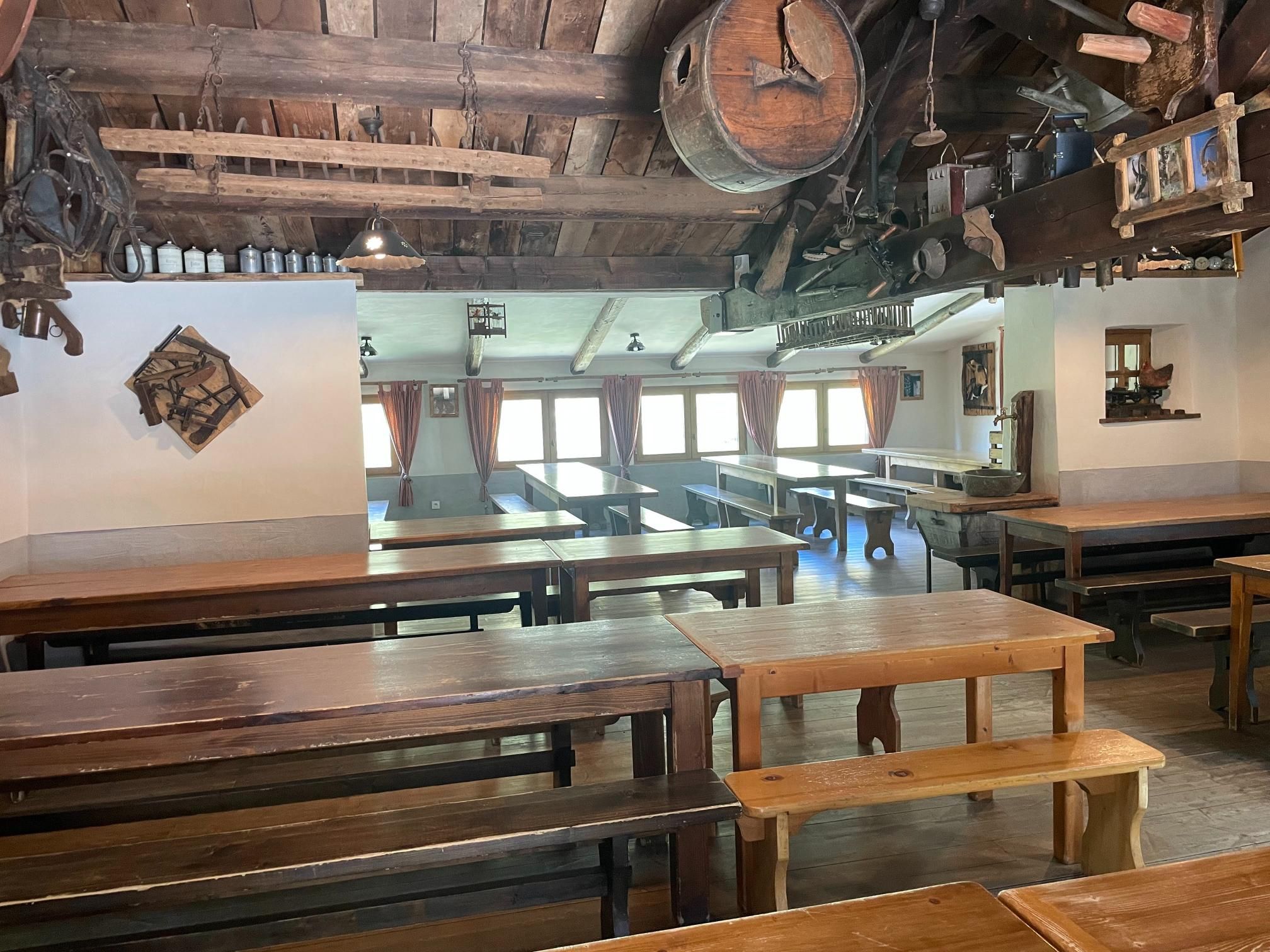
What are Tour du Mont Blanc refuges like?
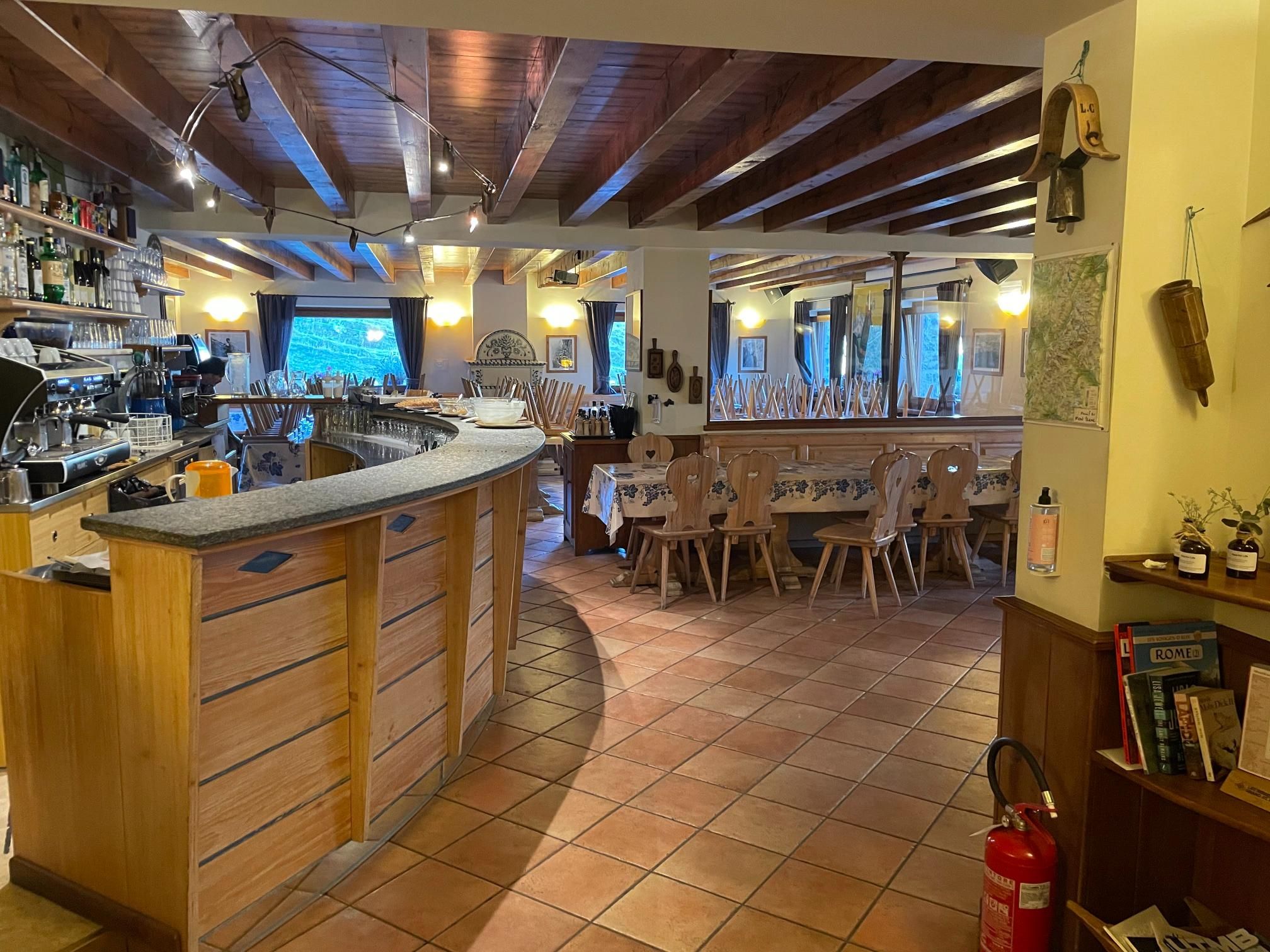
Refuges are shared accommodation with a daily rhythm built around walkers arriving, eating and leaving at similar times.
The association describes typical arrivals between 4pm and 6pm, dinner around 6:30–7pm and quiet nights with early starts. Each property sets its own schedule, so check your confirmation rather than relying on those times everywhere. Official refuge-life FAQ.
Dormitories and private rooms
Dormitories are part of the hut-to-hut experience, but room arrangements differ.
Before booking, distinguish between:
- A bed in a shared dormitory.
- A smaller shared room.
- A room reserved exclusively for your party.
If privacy is important, make it a booking requirement from the start. “Small room” and “private room” are not interchangeable descriptions.
Half-board and packed lunches
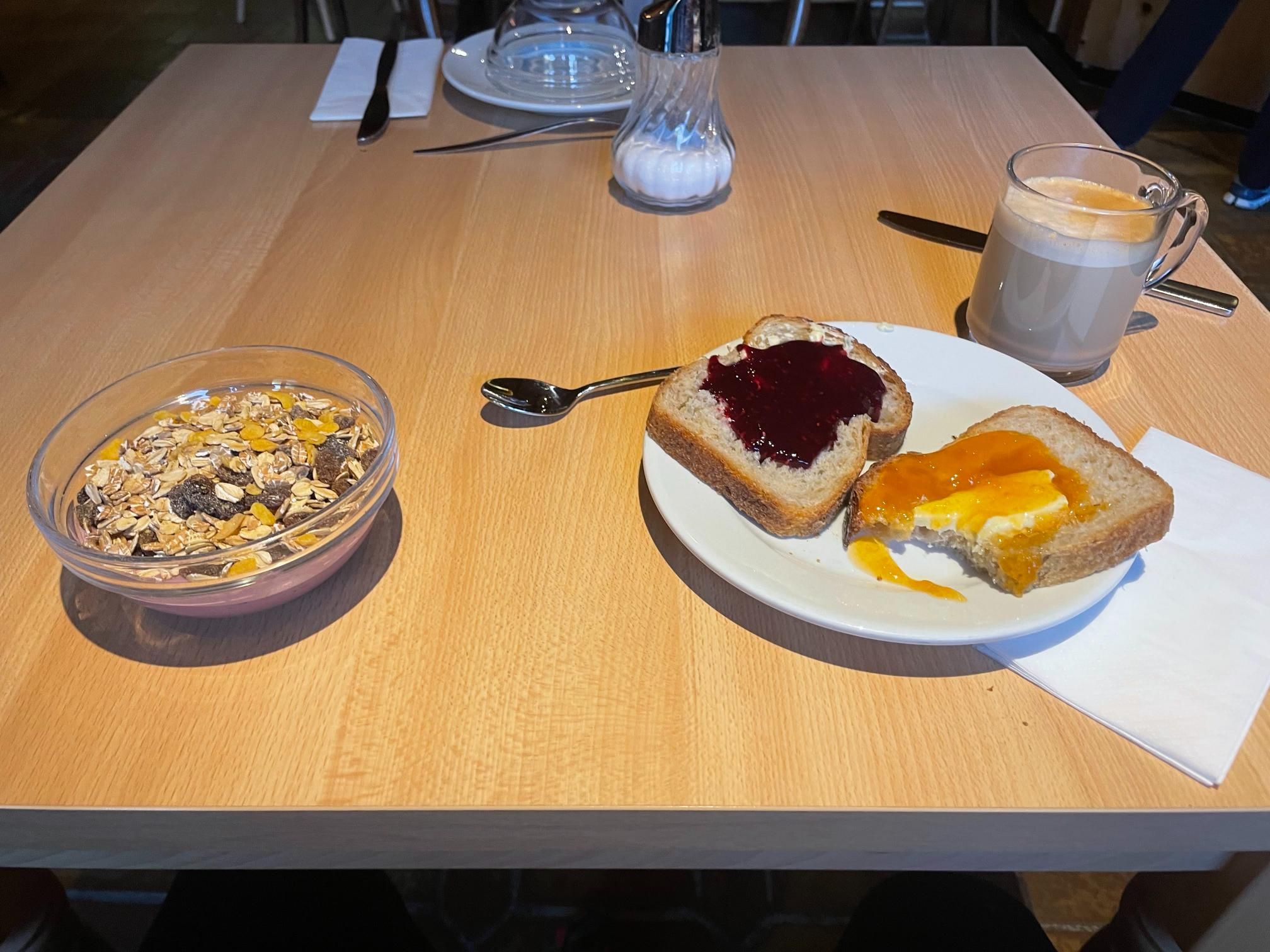
Half-board normally means accommodation, dinner and breakfast. Check the property’s exact inclusions rather than assuming that drinks, lunch, showers and towels are covered.
Packed lunches may need to be ordered separately. Le Peuty, for example, asks guests to order theirs before 5pm on the day of arrival. Le Peuty practical information.
What to bring for a refuge night
Check each accommodation’s requirements, then prepare a small overnight kit:
- Sleeping bag liner where required.
- Earplugs.
- Headtorch.
- Toiletries and a compact towel.
- Booking confirmation and accepted payment method.
Bonatti requires a personal sleeping bag liner in its dormitory and does not include towels in the published rate. Bonatti accommodation details.
Refuge etiquette
Follow the hut’s instructions about footwear, luggage storage, meals and quiet hours. Keep shared spaces clean and let the hosts know if you will arrive late or need to cancel.
Small courtesies make a difference when everyone is sharing the same rooms and facilities. Official refuge good-practice guidance.
Final booking checklist
Before you consider your accommodation plan complete, check that:
- Every overnight date has a confirmed place to stay.
- Your walking days match your fitness and intended route.
- You understand the room arrangement at each property.
- Prices, currencies, taxes and meal inclusions are clear.
- Deposits and outstanding balances are recorded.
- Arrival instructions and cancellation conditions are saved.
- Dietary requirements have been acknowledged.
- Any transfers have been checked separately.
- Confirmations are available offline.
A good TMB accommodation plan gives you more than a bed at the end of the day. It gives the whole trek a workable rhythm.
Explore the TMB accommodation map, compare the accommodation directory, or return to our Tour du Mont Blanc planning guide to build the rest of your trip.